| “So where do you want to go,” he asked “I’m not sure. Just that way, toward the Brandenburg Gate, or maybe past the gate to the Reichstag building,” I said. “You don’t know where you want to go?” He seemed puzzled. I’d begun to realize during my stay that Berliners want precise information and instructions. “Well, I’ve been walking around Berlin all morning, and now I just want a ride—to sit here and go that way,” I said, trying my best to speak clearly and slowly to be understood. Yet I still sensed that he wanted a more defined itinerary. Because I had no clear-cut aim in mind other than “thataway,” he cleverly switched the negotiations from a focus on destination to a focus on the amount of traveling time. “I tell you,” he said, speaking slowly, loudly, and clearly. “For fifteen euros, I drive you for thirty minutes. Then if you want to get out, you get out. If you want me to ride you more, then I ride you more. You decide, ja?” “Ja, ja. Okay—good idea. Let’s go.” I motioned him forward. Where Has It Gone? The bicycle man stood up and pressed hard on the raised pedal with his left foot. This was the only time I saw him strain, as he needed energy to break the inertia and get his taxi going. We were on Ebert Strasse, a street that connects Potsdamer Platz to the Branbenburg Gate to the north. Everything on it looks new, being built after the Berlin Wall came down. It might only have been a few hundred meters wide, but to Germans in the 1960s, ’70s, and ’80s, it was as wide and deep as perilous to cross as the Atlantic Ocean might be in the dead of winter. was discovered accidentally by some road workers digging trenches to lay underground pipe in the 1990s. A few years back, German engineers attempted to demolish the bunker with massive explosive charges, but it was protected by specially formulated reinforced concrete walls 20 feet thick. The walls would not crumble, so they dug a huge hole around the bunker and filled the entire area with fresh concrete, effectively sealing the bunker in a tomb that Germany has pledged not to unearth for another 40 years. The hidden bunker site symbolizes Berlin’ s struggle to come to terms with its wartime actions: Should it to continue to bury and forget, or should it reveal and understand? |
| The Bicycle Man of Berlin (continued) |

As the bicycle began to pick up speed, I looked to my left
and saw a heavily forested area, the beginning of the
Tiergarten, the Central Park of Berlin. To my right was the
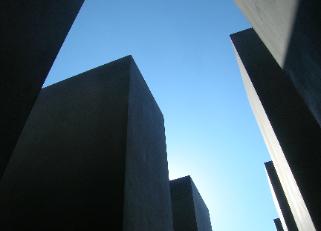
two-acre maze of two thousand large, smooth, gray stone
blocks of the recently completed Holocaust Memorial. I had
learned earlier, on a guided walking tour, that
approximately two hundred yards away from the haunting
memorial is a small patch of grass and dirt that lies
between a parking lot for a group of Soviet-style apartment
buildings and a side street. Forty feet below grade on this
unmarked, ordinary spot of land lay the remains of Hitler’s
fortified bunker, where he spent his final days while Berlin
burned around him and where he ultimately committed
suicide. The bunker’s location, thought to be lost forever,
and saw a heavily forested area, the beginning of the
Tiergarten, the Central Park of Berlin. To my right was the
two-acre maze of two thousand large, smooth, gray stone
blocks of the recently completed Holocaust Memorial. I had
learned earlier, on a guided walking tour, that
approximately two hundred yards away from the haunting
memorial is a small patch of grass and dirt that lies
between a parking lot for a group of Soviet-style apartment
buildings and a side street. Forty feet below grade on this
unmarked, ordinary spot of land lay the remains of Hitler’s
fortified bunker, where he spent his final days while Berlin
burned around him and where he ultimately committed
suicide. The bunker’s location, thought to be lost forever,